A pothole can’t switch to Dark Mode
29/09/2026 · 3 min read
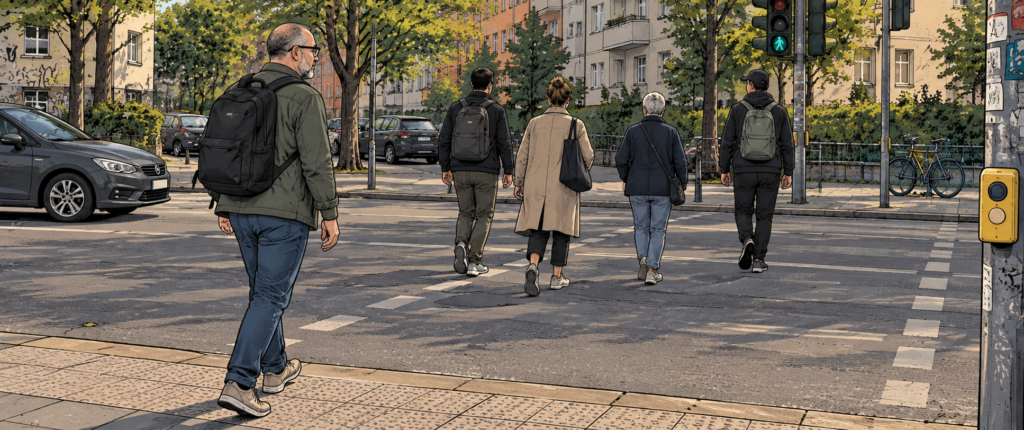
A few weeks ago, I was standing at a traffic light and realised I couldn’t tell which light was illuminated. Not just whether it was red or green — I couldn’t reliably see where the illuminated light was. So I watched the people around me. When they started crossing, I started walking too.
I was diagnosed with cataracts at the beginning of last year, and my eyesight has gradually become worse. At a recent examination, I learned that I’m down to around 40% vision. The good news is that cataract surgery is a standard procedure. In October, I’ll be going to theatre twice: first to have the lens in my right eye replaced, then the left a week later. My doctor told me the actual surgery takes about ten minutes each time. If everything goes as planned, I might end up without glasses for the first time in around 20 years. That’s a pretty great prospect.
For now, though, I’ve stopped cycling. That’s probably the part I miss most. If I can’t reliably recognise a pothole early enough, getting on a bike simply isn’t a particularly clever idea. Driving a car would be even less clever.
At my desk, the same eyes create a very different situation. I dim the lights around me, turn down the screen brightness and use Dark Mode wherever I can. With those adjustments, I can work. Which is mildly ironic, because I used to think Dark Mode was shit.
Some tools don’t support Dark Mode properly, and that’s where things get awkward. In a video call, for example, someone might share a screen that I simply can’t read. I can temporarily invert my entire display to make the shared content readable — but that also inverts everything else, including everyone in the call. I switch it back as soon as I can, because working with permanently inverted colours would be a bloody nightmare. It’s a workaround for something that could simply have adapted in the first place.
My eyesight is impaired. But how much that disables me depends on the environment around me. At my desk, I can change the lighting, lower the screen brightness and use Dark Mode. On the road, I can’t change the traffic light or make a pothole easier to see. In one environment I can adapt things around me. In the other, I am being disabled by them. Disability isn’t only something you have. It is also something the environment can do to you.
None of this is a new idea. Accessibility and usability standards have dealt with adaptability, individualisation and different contexts of use for years. But there’s a difference between understanding that in theory and suddenly depending on it yourself. Something I once considered a preference has become something I need to work.
Right now, adaptability is part of what allows me to keep doing my job. On the road, I don’t have the same option. Software could adapt to my eyes. A pothole can’t switch to Dark Mode.